Filling the sawn edges of
particleboard & lightweight board
The sawn edge of particleboard is porous and full of cavities, and lightweight particleboard even more so. Filling it properly decides whether you can use thinner edge bands, lacquer the edge directly, or replace MDF with a cheaper board.
The method
Choose the board, then the edge
Particleboard can replace MDF and lower the cost of the finished product; lightweight particleboard lowers material cost further. The price of that choice is a more porous sawn edge, which needs filling before edge banding or coating.
Apply automatically, one or two edges at once
An industrial edge filler such as EdgeFill is applied on the line, on one or two edges in a single pass, and levels the cavities instead of just coating them.
Dry fast and sand
Fast drying keeps the line at production speed. A non-shrinking filler stays flush after drying, so one sanding step gives a smooth, closed edge.
Edge band or coat
The filled edge is a stable, even base: edge bands bond evenly and can be thinner, and fully lacquered panels finish surface and edge without a visible transition. Then turn the panel and treat the remaining edges.
Why fills fail
Shrinkage
The fill sinks back into the cavities after drying, and the edge looks wavy under the band or the lacquer.
Chip break-out
An unstabilised sawn edge loses chips during handling, banding or machining.
Poor coating adhesion
A lacquer or coating that does not bond to the filled edge shows lines, gloss differences or peeling.
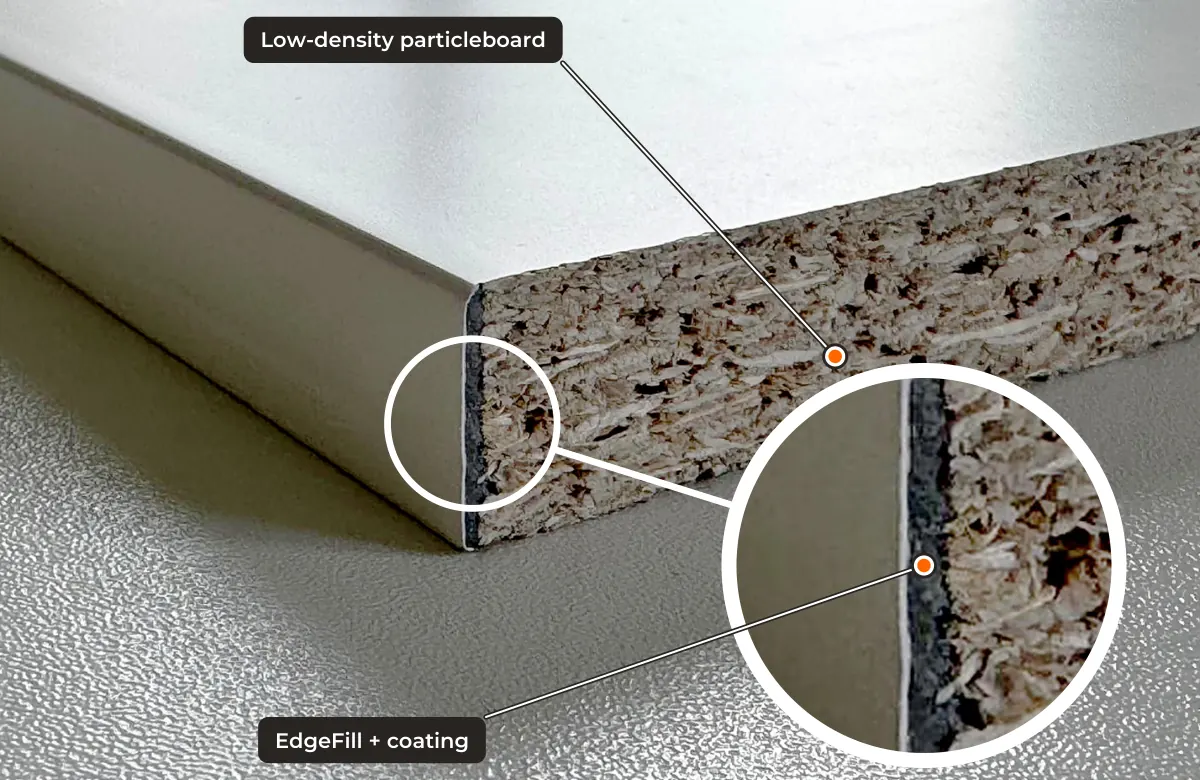
Particleboard with the sawn edge filled by EdgeFill and coated. About EdgeFill →
Common questions
How do I fill the sawn edges of particleboard before edge banding or lacquering?
Apply an industrial, water-based edge filler automatically on one or two edges at once, dry, sand, then edge band or coat. CosmetiWood EdgeFill is developed for exactly this: fast drying, non-shrinking, a very strong bond with wood and excellent adhesion of coatings.
Can particleboard replace MDF for lacquered furniture panels?
Often, yes. Particleboard is cheaper than MDF and lightweight particleboard cheaper still, but their sawn edges are more porous. Filled with an edge filler, the edge becomes smooth and stable enough for thin edge bands or direct lacquering.
Does edge filling make the panel stronger?
No. An edge filler stabilises and upgrades the sawn edge and reduces chip break-out; it is not a structural adhesive and does not reinforce the panel.
Get this right on your own line.
Industrial wood filling solutions: own R&D and production in Dessel, Belgium, with more than 30 years of machine building for the wood industry behind it.
Contact
office@cosmetiwood.com+32 14 37 77 52Contact usStenehei 30/7
2480 Dessel, Belgium
VAT BE0451 447 797
Filling the sawn edges of
particleboard & lightweight board
The sawn edge of particleboard is porous and full of cavities, and lightweight particleboard even more so. Filling it properly decides whether you can use thinner edge bands, lacquer the edge directly, or replace MDF with a cheaper board.
The method
Choose the board, then the edge
Particleboard can replace MDF and lower the cost of the finished product; lightweight particleboard lowers material cost further. The price of that choice is a more porous sawn edge, which needs filling before edge banding or coating.
Apply automatically, one or two edges at once
An industrial edge filler such as EdgeFill is applied on the line, on one or two edges in a single pass, and levels the cavities instead of just coating them.
Dry fast and sand
Fast drying keeps the line at production speed. A non-shrinking filler stays flush after drying, so one sanding step gives a smooth, closed edge.
Edge band or coat
The filled edge is a stable, even base: edge bands bond evenly and can be thinner, and fully lacquered panels finish surface and edge without a visible transition. Then turn the panel and treat the remaining edges.
Why fills fail
Shrinkage
The fill sinks back into the cavities after drying, and the edge looks wavy under the band or the lacquer.
Chip break-out
An unstabilised sawn edge loses chips during handling, banding or machining.
Poor coating adhesion
A lacquer or coating that does not bond to the filled edge shows lines, gloss differences or peeling.
Particleboard with the sawn edge filled by EdgeFill and coated. About EdgeFill →
Common questions
How do I fill the sawn edges of particleboard before edge banding or lacquering?
Apply an industrial, water-based edge filler automatically on one or two edges at once, dry, sand, then edge band or coat. CosmetiWood EdgeFill is developed for exactly this: fast drying, non-shrinking, a very strong bond with wood and excellent adhesion of coatings.
Can particleboard replace MDF for lacquered furniture panels?
Often, yes. Particleboard is cheaper than MDF and lightweight particleboard cheaper still, but their sawn edges are more porous. Filled with an edge filler, the edge becomes smooth and stable enough for thin edge bands or direct lacquering.
Does edge filling make the panel stronger?
No. An edge filler stabilises and upgrades the sawn edge and reduces chip break-out; it is not a structural adhesive and does not reinforce the panel.
Get this right on your own line.
Industrial wood filling solutions: own R&D and production in Dessel, Belgium, with more than 30 years of machine building for the wood industry behind it.
Contact
office@cosmetiwood.com+32 14 37 77 52Contact usStenehei 30/7
2480 Dessel, Belgium
VAT BE0451 447 797