The method
Brush the surface
Loose fibres and dust come off first, so the filler bonds to sound wood.
Apply with a roller coater
A water-based surface filler such as FaceFill is applied over the full surface and fills the irregularities between the strands.
Dry, and add a second coat if needed
A very low water content means no chip lifting and no deformation of the surface. Open boards can take a second coat after drying.
Sand and finish
Sanded flat, the surface takes one or more finishing layers: decorative coatings, or functional systems such as anti-slip, acoustic or anti-adhesion.
Why fills fail
Chip lifting
Too much water in the filler makes the strands swell and stand up, the surface gets rougher instead of flatter.
Telegraphing
The strand pattern shows through the finish because the fill shrank during drying.
Absorption differences
Unfilled porous zones drink the coating and create gloss patches.
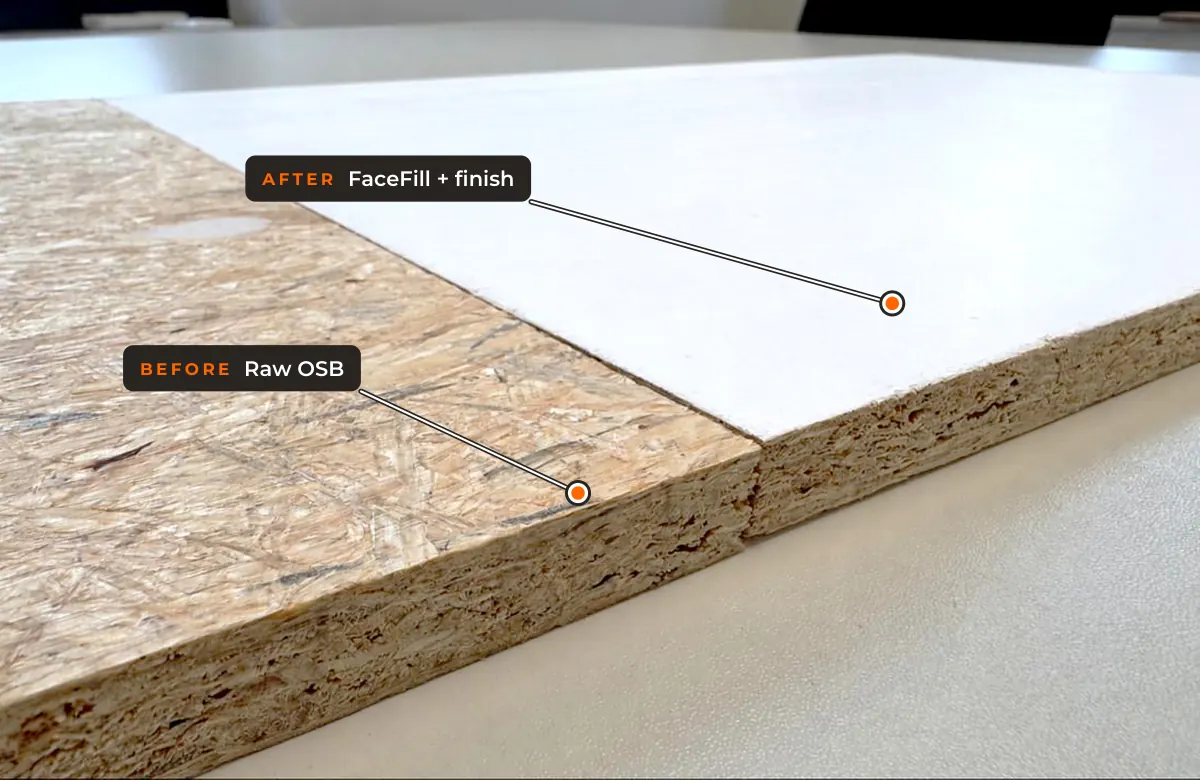
The same OSB panel, raw and filled with FaceFill and finished. About FaceFill →
Common questions
Can OSB be given a smooth, finished surface?
Yes. Filled over the full surface with an industrial filler, dried, sanded and coated, OSB becomes a flat, homogeneous substrate for decorative or functional finishes, while keeping its strength and cost efficiency.
Why does water-based filler on OSB often cause problems?
Because water makes the strands swell and lift. A surface filler for OSB needs a very low water content; CosmetiWood FaceFill is formulated for exactly that, with no chip lifting and no deformation.
What can finished OSB be used for?
Walls, ceilings and floors with a decorative coating, and functional surfaces such as anti-slip, acoustic or anti-adhesion finishes.
Get this right on your own line.
Industrial wood filling solutions: own R&D and production in Dessel, Belgium, with more than 30 years of machine building for the wood industry behind it.
Contact
office@cosmetiwood.com+32 14 37 77 52Contact usStenehei 30/7
2480 Dessel, Belgium
VAT BE0451 447 797
The method
Brush the surface
Loose fibres and dust come off first, so the filler bonds to sound wood.
Apply with a roller coater
A water-based surface filler such as FaceFill is applied over the full surface and fills the irregularities between the strands.
Dry, and add a second coat if needed
A very low water content means no chip lifting and no deformation of the surface. Open boards can take a second coat after drying.
Sand and finish
Sanded flat, the surface takes one or more finishing layers: decorative coatings, or functional systems such as anti-slip, acoustic or anti-adhesion.
Why fills fail
Chip lifting
Too much water in the filler makes the strands swell and stand up, the surface gets rougher instead of flatter.
Telegraphing
The strand pattern shows through the finish because the fill shrank during drying.
Absorption differences
Unfilled porous zones drink the coating and create gloss patches.
The same OSB panel, raw and filled with FaceFill and finished. About FaceFill →
Common questions
Can OSB be given a smooth, finished surface?
Yes. Filled over the full surface with an industrial filler, dried, sanded and coated, OSB becomes a flat, homogeneous substrate for decorative or functional finishes, while keeping its strength and cost efficiency.
Why does water-based filler on OSB often cause problems?
Because water makes the strands swell and lift. A surface filler for OSB needs a very low water content; CosmetiWood FaceFill is formulated for exactly that, with no chip lifting and no deformation.
What can finished OSB be used for?
Walls, ceilings and floors with a decorative coating, and functional surfaces such as anti-slip, acoustic or anti-adhesion finishes.
Get this right on your own line.
Industrial wood filling solutions: own R&D and production in Dessel, Belgium, with more than 30 years of machine building for the wood industry behind it.
Contact
office@cosmetiwood.com+32 14 37 77 52Contact usStenehei 30/7
2480 Dessel, Belgium
VAT BE0451 447 797